AI Product Project
Chosen Angle
A business diagnostic platform that helps identify what may be preventing a business from becoming unforgettable, moving from surface-level marketing symptoms to the underlying gaps that shape whether customers recognize, trust, and remember a brand.
Role
Product Strategist • AI Solutions Designer • Business Analyst
Year
2025
Tools
ChatGPT • Claude • Supabase • Prompt Design
Overview
Visible, but still forgettable
Chosen Angle began with a simple observation: businesses across different industries often market themselves in nearly identical ways. While their services may differ, their messaging, positioning, and customer experience frequently feel interchangeable.
Rather than helping businesses create more content, the goal became identifying what customers were failing to recognize, remember, or connect with.
As the concept evolved, Chosen Angle expanded beyond messaging into a broader business diagnostic platform that evaluates multiple interconnected areas influencing how a business is understood, trusted, chosen, and remembered.
The Business Problem
Most businesses recognize symptoms before they recognize causes.
The instinct is to post more, market harder, lower prices, or rebuild the website. But the underlying gap is often something else: weak differentiation, unclear positioning, limited trust, an ineffective offer, or inconsistent follow-up.
Acting on symptoms costs time and money without moving the business forward. Chosen Angle exists to name the gap first, then point to where the effort belongs.
The Opportunity
Finding what businesses can't see
Create a guided diagnostic experience that helps business owners move beyond generic advice and examine the business from the customer's perspective.
The opportunity was not simply to generate better marketing language. It was to help businesses understand:
- What may be missing.
- Why the business may feel interchangeable.
- Where customer recognition or connection may be breaking down.
- Which area deserves attention first.
- What practical next steps could strengthen the business.
Product Vision
Create a business diagnostic platform that uncovers hidden business gaps, recognizes meaningful patterns across multiple business areas, and transforms those insights into clear, prioritized recommendations.
The product needed to preserve the original recognition-focused philosophy while supporting a broader business diagnostic framework.
My Role
- Product Strategist
- AI Solutions Designer
- Business Analyst
I owned Chosen Angle end to end: the concept, the product plan, the diagnostic structure, the experience design, and every iteration in between.
That meant defining the business problem, mapping the user journey, deciding which business areas the diagnostic would evaluate, shaping the guided interview, and setting the standard for how recommendations are prioritized and presented.
The hardest part was not adding features; it was deciding what to leave out so the product could stay focused on diagnosis before prescription.
Product Approach
Begin with questions, not answers
The product opens with questions rather than a predetermined solution. Each stage moves from surface-level observation to the opportunity most likely to create meaningful improvement.
Observe
Identified a recurring market pattern: businesses with different services were often presenting themselves using nearly identical messaging, content, and positioning.
Discover
Designed a guided interview that gathers context about the business, its audience, offers, customer experience, and growth goals.
Diagnose
Compared signals across business areas to surface blind spots, recognition gaps, and likely root causes.
Prioritize
Turned findings into a ranked set of recommendations so the business knows what deserves attention first.
Core Product Principle
Before recommending a solution, understand what is actually missing.
Chosen Angle was designed to identify underlying business gaps before recommending solutions.
Solution Architecture
Guided Discovery → Business Analysis → Prioritized Recommendations
The platform moves information from the business owner's own answers through a structured analysis layer and into prioritized findings. Each stage exists to improve the quality of the diagnosis before any recommendation is made.
STEP 1
Business Owner
Starts the diagnostic.
STEP 2
Guided Discovery
Collects business context.
STEP 3
Clarification
Asks follow-up questions.
STEP 4
Business Analysis
Compares signals across areas.
STEP 5
Prioritized Findings
Surfaces likely root causes.
STEP 6
Next Steps
Delivers practical actions.
Business Areas Evaluated
These categories are interconnected. The diagnostic is designed to determine which areas are most relevant to the individual business rather than assuming every business needs the same solution.
Business Value
The architecture demonstrates how product strategy, business analysis, and AI-assisted reasoning can be combined into a structured diagnostic experience. The framework was intentionally designed to support additional diagnostic categories, industry-specific assessments, and deeper recommendation logic over time.
Project Status: The core product experience has been designed and built and is currently undergoing final refinement and testing. Outcomes will be measured once the product is released and tested.
Key Product Decisions
Choices that shaped the experience
Recognition Before Promotion
Focused first on whether customers recognize themselves, their needs, or their desired outcome in the business. That meant deprioritizing content generation in favor of clarity before reach.
Root Causes Before Symptoms
Designed the diagnostic to look beneath visible challenges such as low engagement or weak sales before suggesting solutions, so the product does not prescribe before it understands.
Connected Business Analysis
Evaluated multiple areas of the business because messaging, trust, pricing, offers, customer experience, and retention can influence one another.
Guided Discovery
Used a structured interview experience instead of asking users to describe the entire problem without support, reducing ambiguity and improving input quality.
Prioritized Recommendations
Designed outputs to help users understand where to begin rather than overwhelming them with an unranked list of improvements.
Scalable Framework
Created the product structure so additional diagnostic categories, industry-specific assessments, and deeper recommendations can be introduced over time.
User Journey
The intended user flow
- 1
Founder Discovery
The user answers guided questions about the business, audience, offers, challenges, and goals. The quality of the diagnosis depends on the quality of the inputs.
- 2
Clarification
The advisor asks follow-up questions when additional context is needed, surfacing details that a single answer cannot capture.
- 3
Business Diagnosis
The system analyzes patterns, possible blind spots, and gaps across relevant business areas so the business sees where recognition or trust may be breaking down.
- 4
Prioritized Findings
The user receives an organized explanation of what may be preventing the business from becoming more recognizable, trusted, or memorable, focusing on likely root causes rather than symptoms.
- 5
Practical Next Steps
The experience provides recommendations the business can evaluate and begin implementing, turning insight into action without overwhelming the user.
Product Walkthrough
Follow the guided diagnostic experience from the first interaction through structured discovery, business analysis, and prioritized recommendations.
Product Entry Point
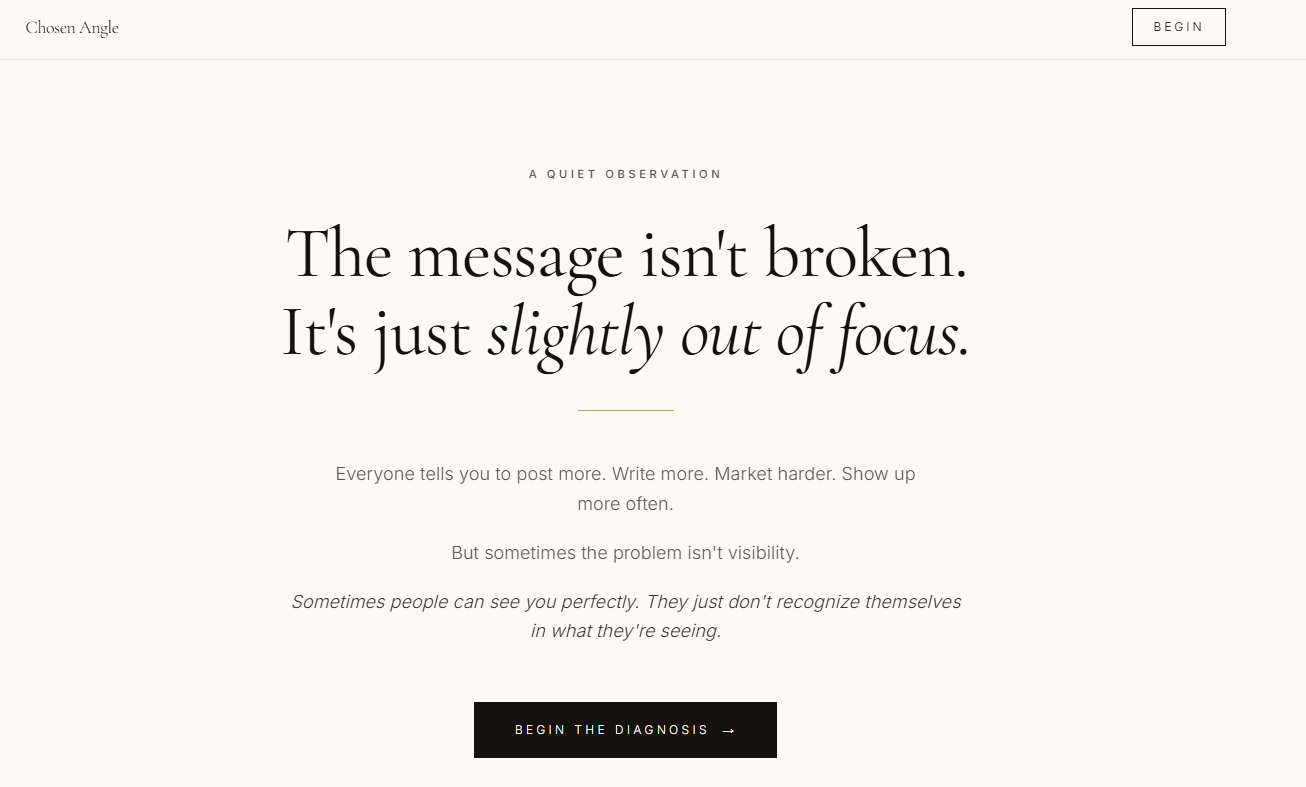
The homepage introduces the recognition-focused premise of the product and invites the business owner into the guided diagnostic.
Guided Discovery
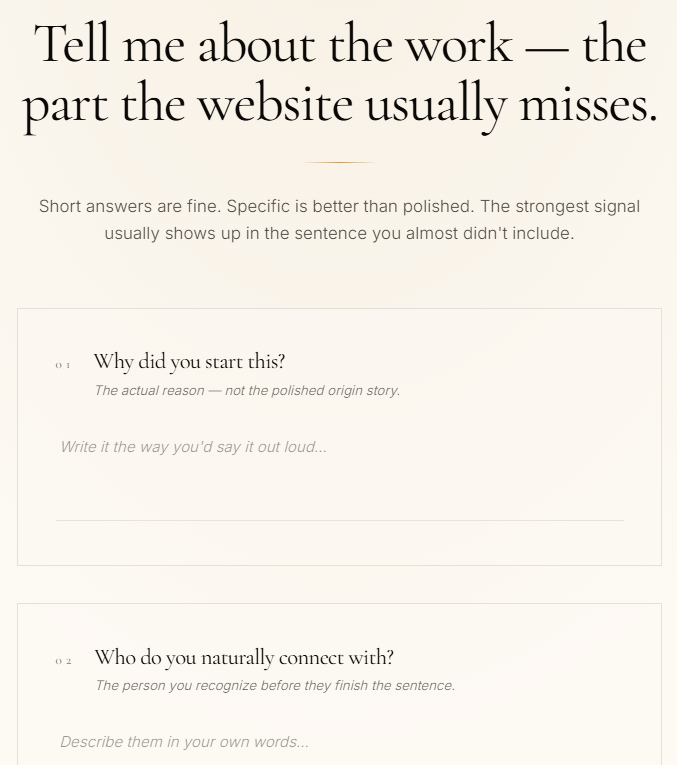
The guided interview collects structured context about the business, its audience, and its goals before any analysis begins.
Content Collection
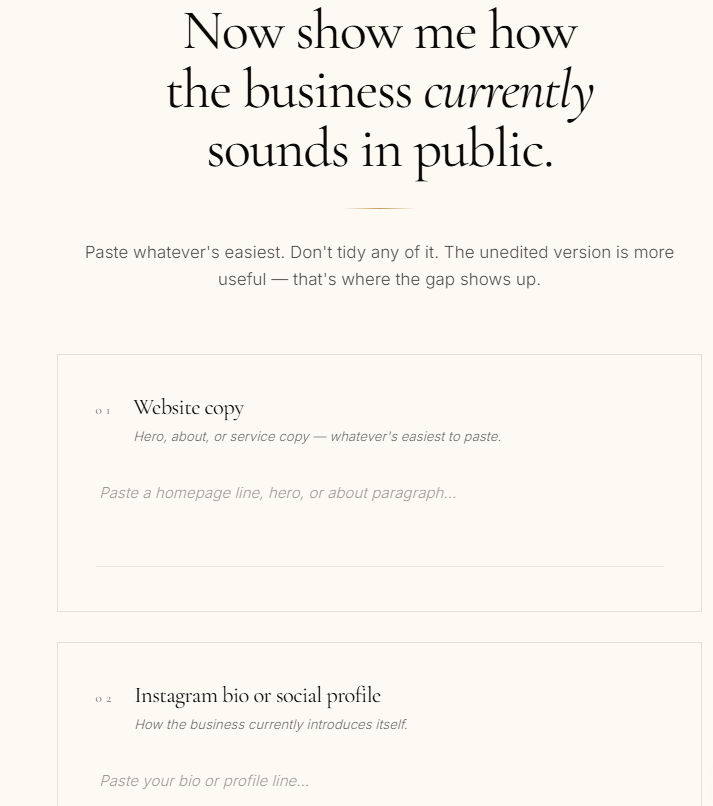
The experience gathers how the business currently sounds in public so the diagnostic can compare intent against expression.
Diagnostic Findings
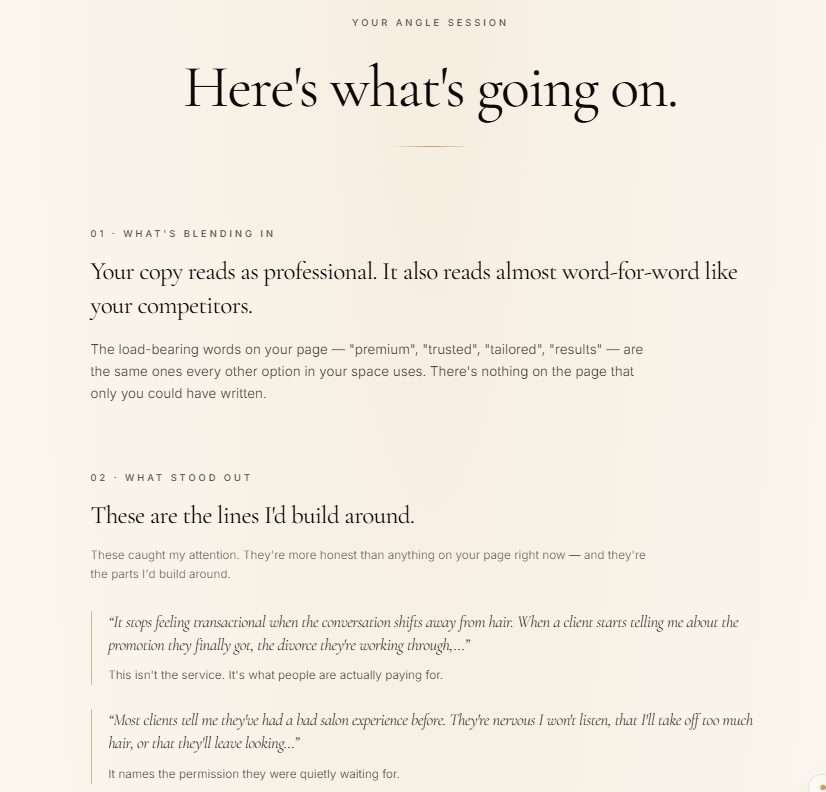
Findings are organized into what is blending in and what stood out, framing likely root causes rather than surface symptoms.
Working Toolkit
Tools and disciplines used
Current Product Stage
- Core product concept and experience designed.
- Recognition-focused homepage completed.
- Guided diagnostic experience developed.
- Business evaluation framework established.
- Report and recommendation structure in refinement.
- Final functionality, testing, and quality assurance in progress.
This case study documents the strategy, framework, and design decisions behind Chosen Angle while the product is in active development. Outcomes will be measured once the product is released and tested.
What I Learned
Translating a market pattern into a product
Turning an observed market pattern into a structured product concept takes more discipline than I expected. The idea is easy; the framing, boundaries, and sequencing are not.
The problem a user reports is rarely the problem worth solving. The diagnostic had to organize interconnected business information, design follow-up questions that earn better inputs, and present findings clearly without overstating certainty.
It also reshaped how I think about scope. What began as a messaging tool became a platform for evaluating the business as a connected system once the real problem came into focus.
Future Roadmap
Where the product goes next
- 01
Complete final product refinement and quality assurance before broader testing.
- 02
Strengthen diagnostic logic and the follow-up questioning that improves accuracy.
- 03
Refine how recommendations are prioritized and presented.
- 04
Conduct user testing and gather structured feedback.
- 05
Use validated feedback to guide the next phase of development.
Explore Another Project
Explore another case study demonstrating a different aspect of my approach to product strategy, business analysis, workflow design, and AI-powered solutions.