Workflow Automation Project
Dry Hire Mobile Bar Booking Automation
Designed and built an automated booking workflow that captures customer inquiries, routes submissions through an integrated workflow, and delivers professionally formatted booking notifications to the business owner in real time.
Role
Business Analyst • Workflow Designer • Automation Builder
Year
2026
Tools
Tally • Make • SMTP • SiteGround • Prompt Engineering
Overview
Simplifying the booking process through automation
This project focused on simplifying the booking process for a mobile bar business by replacing manual inquiry handling with an automated workflow. The solution captures customer information through a guided booking form, processes submissions through Make, and sends structured HTML email notifications using SMTP. The workflow was designed to reduce manual effort, improve response time, and ensure every booking inquiry arrives with complete, organized information.
The Business Problem
The booking process relied on manual form submissions and email monitoring, making it easy to miss customer inquiries and slowing response times.
A dry hire mobile bar business was receiving booking inquiries through fragmented channels and manually copying details into emails, calendars, and spreadsheets.
The process was slow, error-prone, and created delays in responding to potential customers. The business needed an automated workflow that would instantly notify the owner whenever a new booking request was submitted.
The Opportunity
Eliminate manual monitoring and respond faster
Create an automated booking workflow that captures inquiries, formats the data, and instantly notifies the owner — all without manual intervention.
The opportunity was not just to connect tools. It was to remove the manual gap between a customer expressing interest and the business owner receiving the request.
- Reduce manual email monitoring.
- Improve response time to booking inquiries.
- Lower the risk of missed customer requests.
- Remove repetitive administrative copying and data entry.
- Create a scalable foundation for future integrations.
Product Vision
Design and deploy an automated workflow that instantly sends booking notifications whenever a customer submits a booking request.
The automation should include the booking form, automation platform, webhook integration, SMTP connection, dynamic field mapping, and live testing — all built around the actual business workflow.
My Role
- Business Analysis
- Workflow Design
- Automation Building
I served as the Business Analyst and Workflow Automation Builder for this project. My role was to understand the current booking process, identify the manual bottlenecks, design a structured intake form, build the automation in Make.com, configure SMTP email delivery, and validate the end-to-end workflow.
I also documented the workflow so the business can maintain it and scale it as future integrations are added.
Product Approach
From manual process to automated workflow
I approached the project by first understanding the existing booking workflow, then designing an automation that removed the manual steps while keeping the customer experience simple and the business owner informed.
Analyze
Analyzed the booking workflow and identified manual bottlenecks where inquiries were being handled through fragmented channels.
Map
Mapped the customer journey from form submission through notification delivery to understand every touchpoint.
Form
Built a structured booking form using Tally to capture consistent customer details and reduce missing information.
Automate
Created an automated workflow in Make.com using webhooks to receive, process, and route booking submissions.
Connect
Configured SMTP email delivery using SiteGround email to send instant notifications directly from the business domain.
Map Fields
Mapped booking form fields into dynamic email notifications so every message contains the right customer details.
Test
Tested the workflow with live booking submissions to verify triggers, formatting, and delivery.
Validate
Validated successful end-to-end automation and email delivery before handing the workflow over.
Core Product Principle
Understand the workflow before automating it.
Automation should be built around the actual business process, not around the tools themselves. By identifying where manual effort occurred first, I created a solution that delivers immediate value and remains flexible for future enhancements.
Key Product Decisions
Choices that shaped the workflow
Tally Booking Form
Selected Tally for the booking form because it is lightweight, easy to maintain, and captures structured data consistently without custom development.
Make.com Automation
Chose Make.com to handle the automation logic, enabling webhook triggers, data formatting, and conditional routing without writing backend code.
Webhook Integration
Used webhooks to connect the Tally form directly to Make.com, ensuring submissions trigger the workflow instantly.
SMTP Email Connection
Connected the business's SiteGround email account via SMTP so notifications arrive from a trusted domain instead of a third-party sender.
Dynamic Field Mapping
Mapped form fields into dynamic email content so every notification contains the customer name, event details, and contact information.
Live Workflow Testing
Tested the full workflow with real submissions to confirm that the form, webhook, automation, and email delivery work together reliably.
Solution Architecture
Customer Request → Automated Processing → Business Notification
The solution automates the booking inquiry process by creating a seamless flow from customer submission to business notification. Each component reduces manual effort while ensuring booking requests are captured consistently and delivered in a structured format.
STEP 1
Customer Request
Customer submits booking.
STEP 2
Tally Form
Captures booking information.
STEP 3
Webhook
Starts the workflow.
STEP 4
Make.com
Processes and formats data.
STEP 5
SMTP Email
Sends notification.
STEP 6
Business Owner
Receives booking instantly.
Business Value
This workflow demonstrates how business analysis, workflow design, and automation can simplify a manual process while creating a scalable foundation for future enhancements. The solution was intentionally designed to support future integrations such as CRM synchronization, online payments, appointment scheduling, reporting dashboards, and automated customer communications.
Project Status: This solution has been fully designed, built, and validated through end-to-end testing as a working prototype. It has not yet been deployed into a live production environment.
Implementation Evidence
Follow the booking request as it moves through each stage of the automated workflow—from customer submission to business notification.
Customer Intake
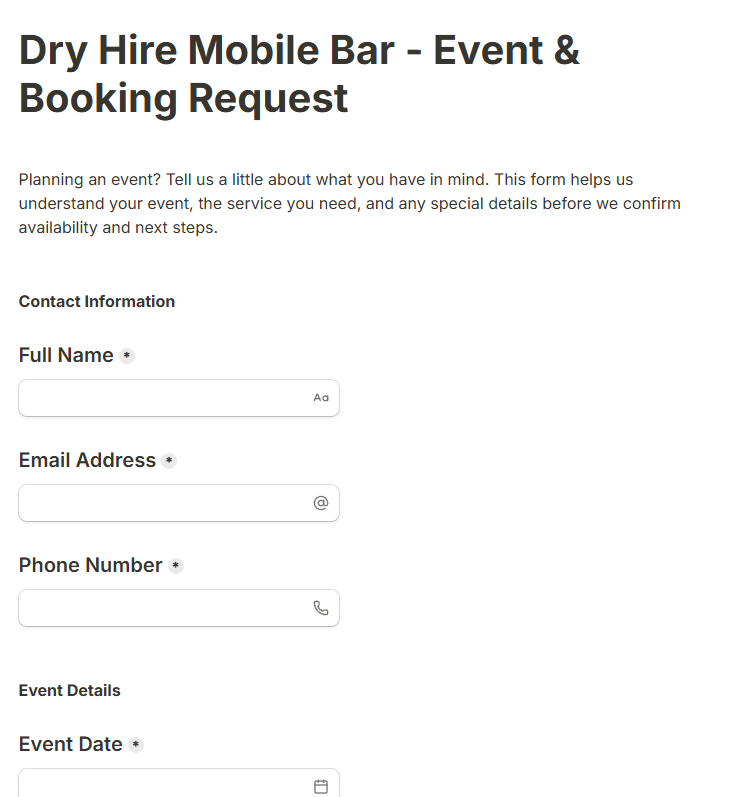
Customers submit their event information through a structured intake form designed to capture consistent booking details.
Data Capture
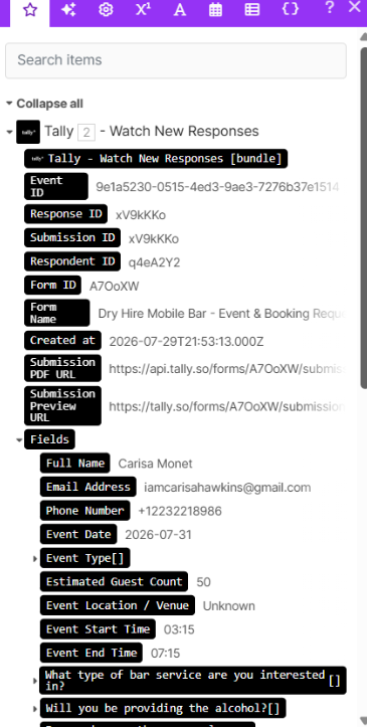
Each booking request is received as structured data, ensuring the automation has complete customer and event information before processing.
Automation
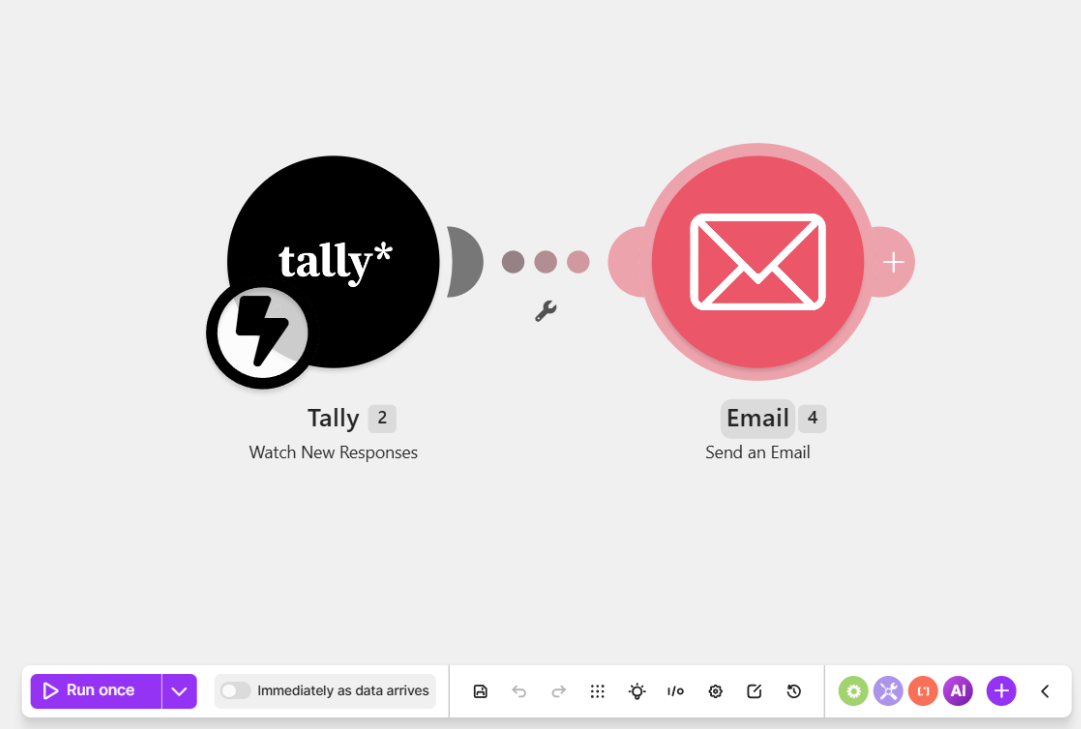
Make.com monitors new submissions, triggers the workflow, and routes the booking information through the automation without manual intervention.
Email Delivery
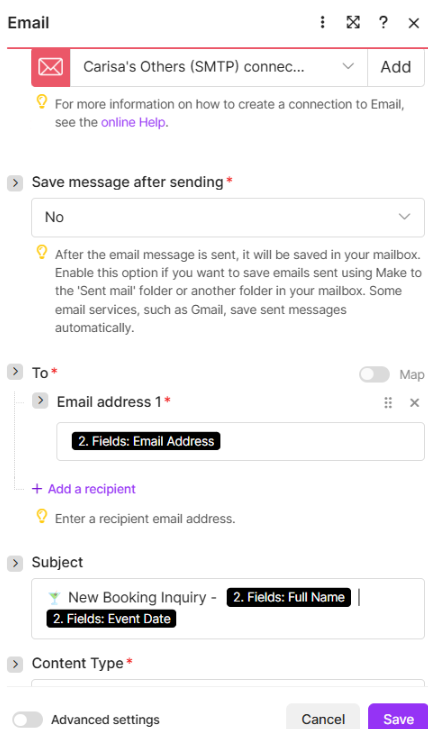
The SMTP module dynamically maps customer and event details into a branded notification email before delivery.
Business Notification
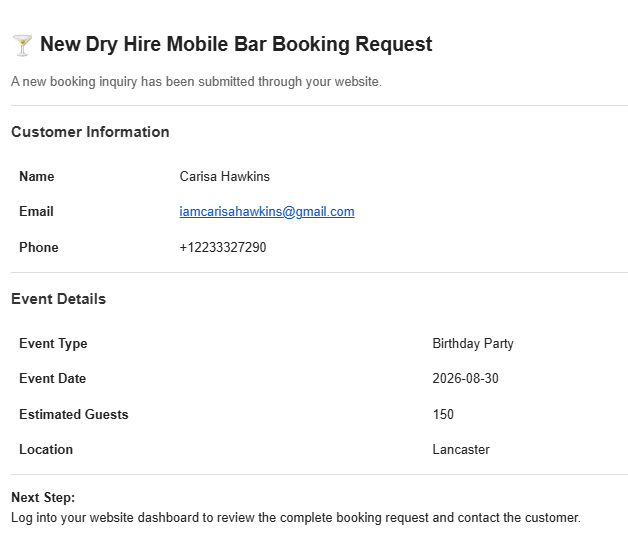
The business owner receives a formatted booking notification containing all submitted customer and event details, ready for follow-up.
Working Toolkit
Tools and disciplines used
Current Product Stage
- Booking workflow mapped and documented.
- Structured Tally form created and deployed.
- Make.com automation scenario built and tested.
- SMTP email connection configured and validated.
- Dynamic field mapping implemented in notifications.
- Live end-to-end testing completed successfully.
The workflow has been built and validated through end-to-end testing. It is ready for deployment and future production use.
Project Status
This project has been fully analyzed, designed, built, and tested as a working workflow automation prototype. While it has not yet been deployed in a live production environment, every component has been validated through end-to-end testing to demonstrate the intended business process.
- Business workflow analyzed and documented
- Customer intake form designed and built in Tally
- Make.com automation workflow created
- Webhook integration configured
- Dynamic field mapping completed
- SMTP email delivery configured using the business domain
- End-to-end workflow successfully tested
- Documentation prepared for future enhancements
This project demonstrates my ability to analyze an existing business process, identify workflow bottlenecks, design an automation strategy, build a working solution, validate the complete workflow, and prepare it for future production deployment. While the workflow has not yet been launched for a live client, the prototype demonstrates the complete business analysis, workflow design, and automation development process.
What I Learned
Understanding the workflow first
This project reinforced the importance of understanding the business workflow before building the automation. By first identifying where manual effort occurred, I was able to create a simple solution that provides immediate business value while remaining flexible enough to support future enhancements.
The real value of the project was not in connecting tools. It was in designing the workflow around the business's actual process and then choosing the right tools to support that process.
Future Roadmap
Where the product goes next
- 01
Calendar availability synchronization
- 02
CRM integration to manage leads and customer history
- 03
Online payment collection and booking confirmation workflow
- 04
Automated reminder emails and SMS notifications
- 05
Owner dashboard for managing booking requests and statuses
- 06
Analytics and reporting to monitor inquiry volume and conversion trends
Explore Another Project
Each project in this portfolio highlights a different aspect of my approach to solving business problems through thoughtful product planning, analysis, and design.