Project
Angle Sessions
Designing a diagnostic service that uncovers the real business problem before recommending solutions.
I designed Angle Sessions after identifying a common challenge: business owners can consistently market what they do and still struggle to understand why their message is not connecting.
Rather than beginning with more content or another marketing tactic, I designed a service that starts by identifying what may be missing.
Role
Product Strategy · Business Analysis · Service Design
Project
Independent Business Project
Status
Built · Pre-Launch
The Problem
Business owners may recognize the symptoms: they are creating content, presenting their services, and showing up consistently, but attention does not necessarily turn into interest or action.
The harder question is why.
When someone is deeply familiar with their own business, they have context their audience does not. Important information can feel obvious internally while remaining unclear externally.
This creates potential blind spots across positioning, messaging, audience connection, offers, and the customer experience.
The challenge was not simply creating better content. It was creating a structured way to identify where the connection might be breaking.
The Product Insight
Where messages may be losing their connection
In defining the problem, I identified several potential points of disconnect:
Audience Gap
The message may reach people without clearly signaling who the offer is for.
Messaging Gap
The business understands its value, but that value may not be communicated clearly to an outside audience.
Connection Gap
Content may explain what the business does without giving the audience a compelling reason to care or recognize themselves in the experience.
Founder Blind Spot
Business owners naturally carry context about their business that their audience does not, making some communication gaps difficult to recognize from inside the business.
Product Insight
The business may not need more marketing activity. It may first need a better diagnosis of what is preventing the existing activity from connecting.
From Positioning to Delivery
Follow the service as it moves from the landing experience through positioning, session outcomes, and the booking flow.
Service Landing Page
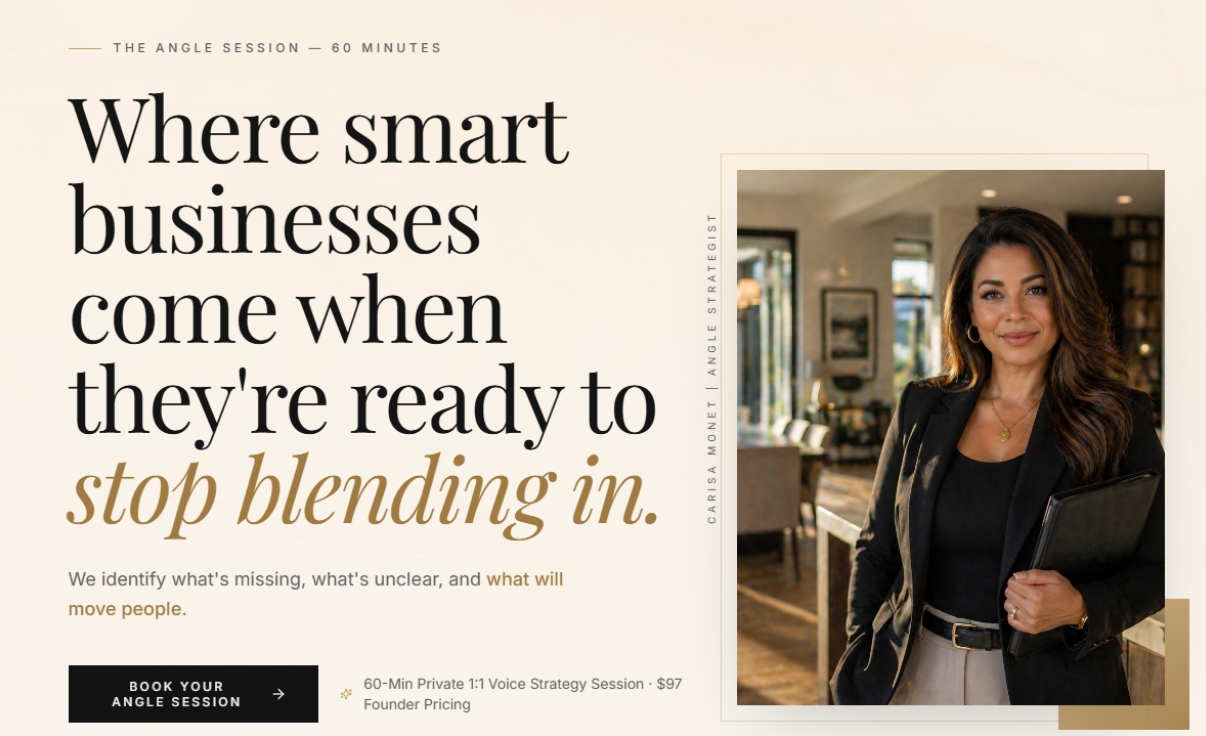
Introduces the business problem, positions the diagnostic, and establishes the value of the service.
Service Positioning
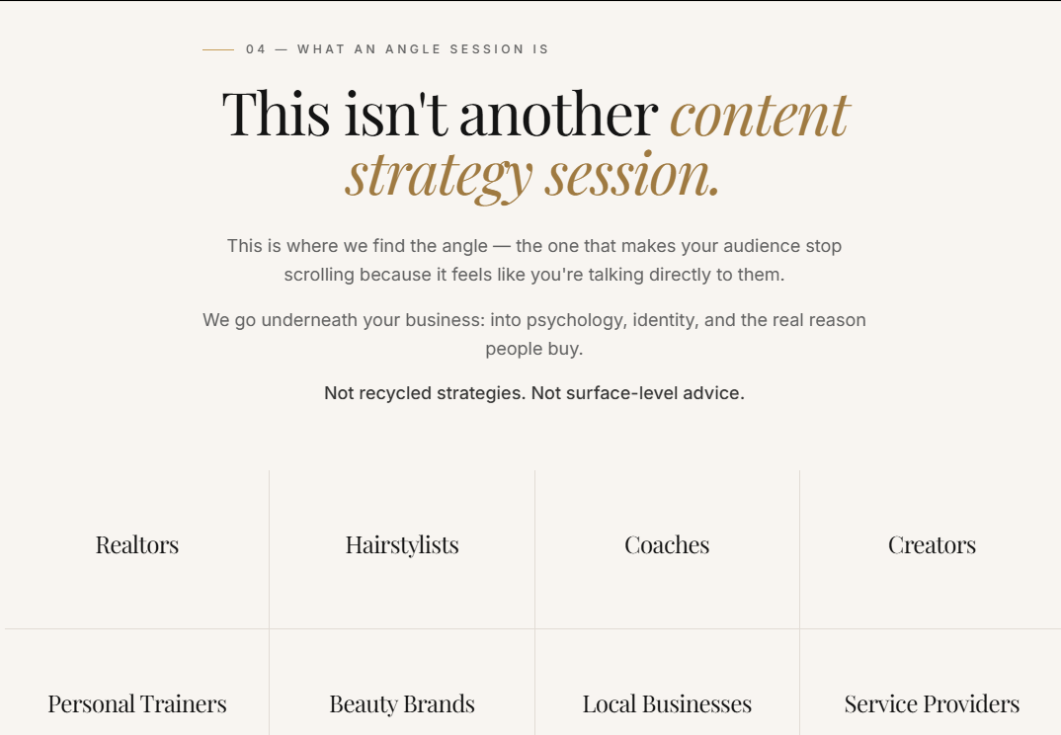
Differentiates the service by focusing on diagnosis before recommending marketing tactics.
Session Outcomes
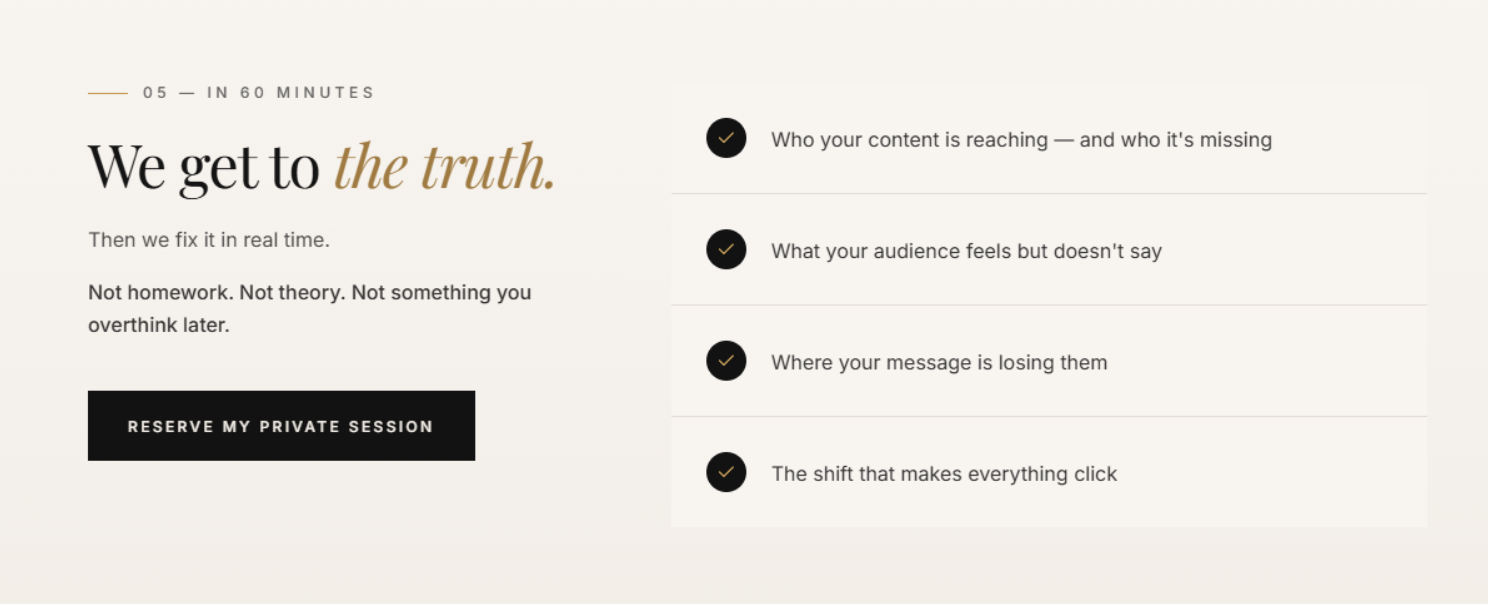
Shows the clarity, direction, and messaging clients can expect to leave with.
Pricing & Booking
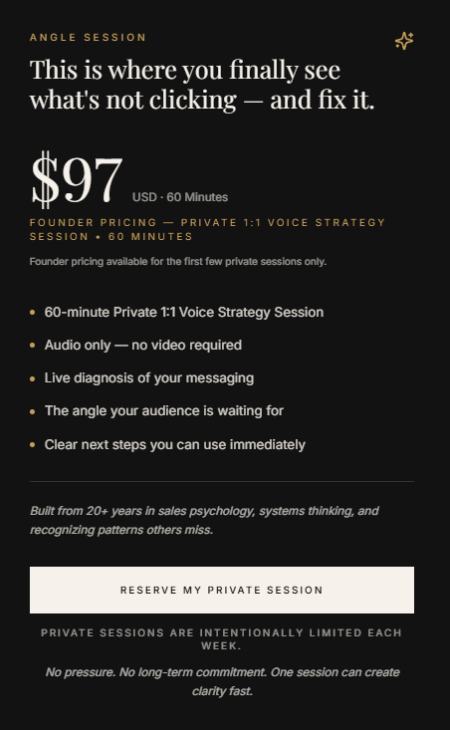
Demonstrates how the service is packaged, priced, and prepared for launch.
My Approach
Diagnosis, not a predetermined marketing solution
Instead of beginning with a predetermined marketing solution, I structured Angle Sessions around diagnosis. The analytical progression is:
01
What is happening
02
Where is the disconnect
03
What may be causing it
04
What needs to change
This reframed the service from generic marketing advice into a focused problem-solving experience.
Translating the Insight into a Product
A focused format matched to the problem
Once the problem was defined, I evaluated what type of solution best fit it.
I deliberately designed Angle Sessions as a focused 60-minute private diagnostic session rather than a course, long-term coaching program, content calendar, social media management service, or open-ended consulting engagement.
The problem being addressed is lack of clarity. The solution therefore needed to reduce complexity rather than create more work for the business owner.
Who It Is Designed For
Owner-led and personal-brand businesses
Angle Sessions is designed primarily for owner-led and personal-brand businesses where messaging and positioning strongly influence customer decisions.
Potential users include:
The common condition matters more than the industry: they are already trying to market the business, sense that something is not connecting, and cannot clearly identify what needs to change.
Business Areas Evaluated
A structured view of the business
Key Product Decisions
Choices that shaped the session
Diagnosis Before Tactics
The service begins by exploring the underlying disconnect rather than automatically recommending more content.
Structured Discovery
The session uses guided questions to understand the business, audience, offer, current activity, and perceived problem before recommendations are developed.
One Focused Session
A contained 60-minute format reduces commitment and keeps the service centered on one defined problem.
Real-Time Analysis
The session is designed around examining the business and its messaging during the conversation rather than assigning extensive preliminary work.
Human-Led Interpretation
AI may assist with organizing information and identifying patterns, but interpretation and final recommendations remain human-led.
Actionable Direction
The session is designed to produce clearer messaging direction, stronger angles, positioning recommendations, and defined next steps.
User Experience
Service flow
Guided Discovery
Diagnostic Conversation
Analysis
Prioritized Findings
Actionable Direction
The experience was designed to move from symptoms to potential causes before moving to recommendations. This keeps the service focused on understanding the problem before prescribing a solution.
Business Model & Implementation
A productized professional service
Angle Sessions was designed as a productized professional service rather than open-ended consulting.
Format
Private 1:1 session
Length
60 minutes
Initial Launch Price
$97
Delivery
Voice session
Booking
Online scheduling and payment flow
Development Stage
Pre-Launch Validation Complete
Pre-Launch Testing
Simulated Pre-Launch TestingBefore launch, I used simulated business scenarios and role-play sessions to test the discovery process, diagnostic questioning, and ability of the framework to move from a visible symptom toward a more useful underlying business problem.
One documented hairstylist simulation began with what appeared to be a content-performance problem. Through the diagnostic conversation, the issue was reframed as a connection problem: prospective customers could see the content, but the experience was not helping them clearly picture themselves as the customer.
The simulation helped test how the questioning framework could move beyond the initial complaint and uncover a more specific problem to investigate.
Project Outcome
Angle Sessions progressed from an initial concept into a defined, pre-launch productized service with positioning, target users, a diagnostic framework, session structure, pricing, customer journey, landing page, payment integration, and booking infrastructure.
The project demonstrates my ability to move from an ambiguous business problem to a structured and implementable solution.
Because Angle Sessions has not yet launched or served clients, this project does not claim customer, revenue, conversion, or performance outcomes.
What This Project Demonstrates
Skills applied end-to-end
Business Analysis
Moving from visible symptoms toward underlying gaps before defining a solution.
Product Strategy
Translating an observed problem into a defined service with users, positioning, scope, pricing, and delivery.
Customer Experience
Designing the journey from problem recognition through understanding the offer and booking the service.
Systems Thinking
Connecting messaging, positioning, service delivery, scheduling, payment, and the customer experience.
Implementation
Moving beyond ideation to build the customer-facing offer and supporting infrastructure.
What I Learned
Defining the problem first changes the solution
The strongest solution is not always the one with the most features. Defining the actual problem first can reveal that a smaller, more focused intervention is more useful than adding another tool, tactic, or process.
Pre-launch simulation also reinforced the importance of testing the questions themselves. A diagnostic framework is only useful if the conversation can move beyond the first visible symptom and help surface a more specific problem worth solving.
Next Iteration
After launch
After launch, the next phase is to:
- 01
Conduct real Angle Sessions and collect structured feedback.
- 02
Evaluate where users enter the booking journey and where they drop off.
- 03
Identify patterns that emerge across real sessions.
- 04
Refine the diagnostic framework based on actual use.
- 05
Determine which repeated findings could support future products or tools.
Explore Another Project
Each project in this portfolio highlights a different aspect of my approach to solving business problems through thoughtful product planning, analysis, and design.